Can you climb Mount Vesuvius
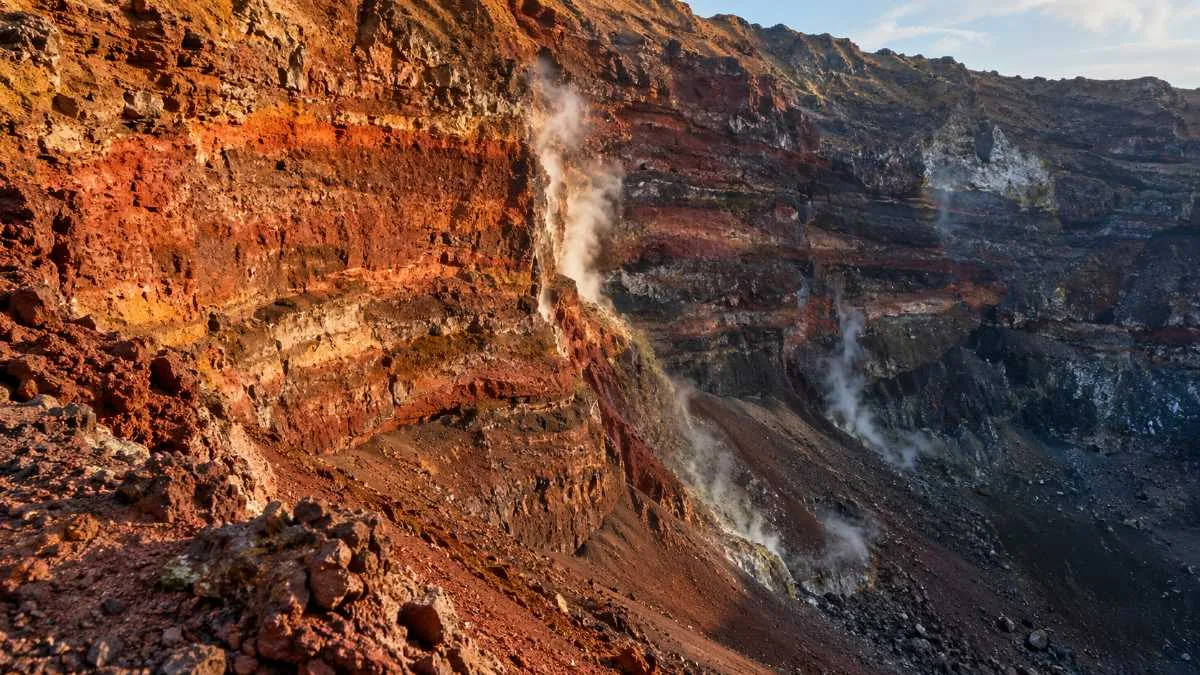
How far the wheel takes you
Vesuvius is about 1,281 metres high and lies within a national park established in 1995. Cars and coaches reach a square at around 1,000 metres, where everyone stops without exception. From there, Trail No. 5 begins, circling the cone and climbing to the rim. Those expecting to find transport for the last stretch are relying on a memory from eighty years ago: the 1880 funicular, the one from the song, was destroyed by the March 1944 eruption and has never been restored.
The ticket is a time slot, not a full day
This is the difference that causes arguments at the gate. Entry to the crater trail works on time slots: you book a window and arrive within that window. Arriving with the wrong slot, or without a slot on a busy day, means waiting or not going up. How to book, and what changes between buying just the ticket or purchasing it as part of a tour, is explained in crater tickets.
Who can manage it and who struggles
It’s not mountaineering. It’s a steady half-hour climb on lapilli, the loose volcanic gravel covering the entire cone. Uphill, it slows your step; downhill, it rolls underfoot. Anyone who walks normally reaches the top without issue, taking a break if needed. Those with mobility issues, heart conditions, or vertigo should read first if it’s safe to climb: some organised options explicitly exclude these conditions.
The trail is not wheelchair-accessible and cannot be tackled with a stroller. This is not a precautionary recommendation, but an observation about the terrain. With small children, you carry them in your arms or in a child carrier backpack: we discuss this in Visiting Mount Vesuvius with children.
When the climb is not possible
Strong winds, storms, and snow close the trail, sometimes with just a few hours’ notice. It’s not the operator’s decision, and that’s why on this mountain free cancellation is more valuable than elsewhere. What actually happens when the park closes—refunds, date changes, substitute excursions to Herculaneum—can be found in Vesuvius closed due to bad weather.
What to have with you
Closed shoes with a grippy sole, water, something for the wind even in summer, and sun protection: there’s no shade on the cone. Near the top there are a couple of stalls selling water and souvenirs, but relying on them as your only water supply is risky. The full list is in what to bring to Mount Vesuvius.
If you only have an afternoon and don’t want to think about anything, choose an option that already includes the ticket and transport. The walk up remains—no one can take that away—and it’s the part that makes the trip worthwhile.
Book your time slot for the crater
The skip-the-line ticket with digital guide is the most straightforward way to secure the right time, with or without the transfer from Naples or Pompeii.
Frequently asked questions
Can you drive to the top of Mount Vesuvius by car?
No. By car or bus, you reach a parking area at around 1,000 metres. The final stretch to the crater’s edge takes 25–30 minutes on foot over volcanic gravel.
Is there a funicular or a cable car?
No. The historic funicular was destroyed by the 1944 eruption and was never rebuilt. Today, the only way to reach the rim is on foot.
Do you need to book to go up Vesuvius?
Yes. Entry to the Gran Cono trail operates on a time-slot basis and must be booked in advance. The options are explained in the crater tickets.
How long does the whole trip take, from the car park and back?
The total time for the ascent, walk along the rim, and descent is usually between one hour and one and a half hours. Actual times are in how long the climb takes.
Can you go down into the crater?
No. You walk along the rim, not inside. What you see from up there is explained in what you can see from the crater.