Mount Vesuvius, the complete guide
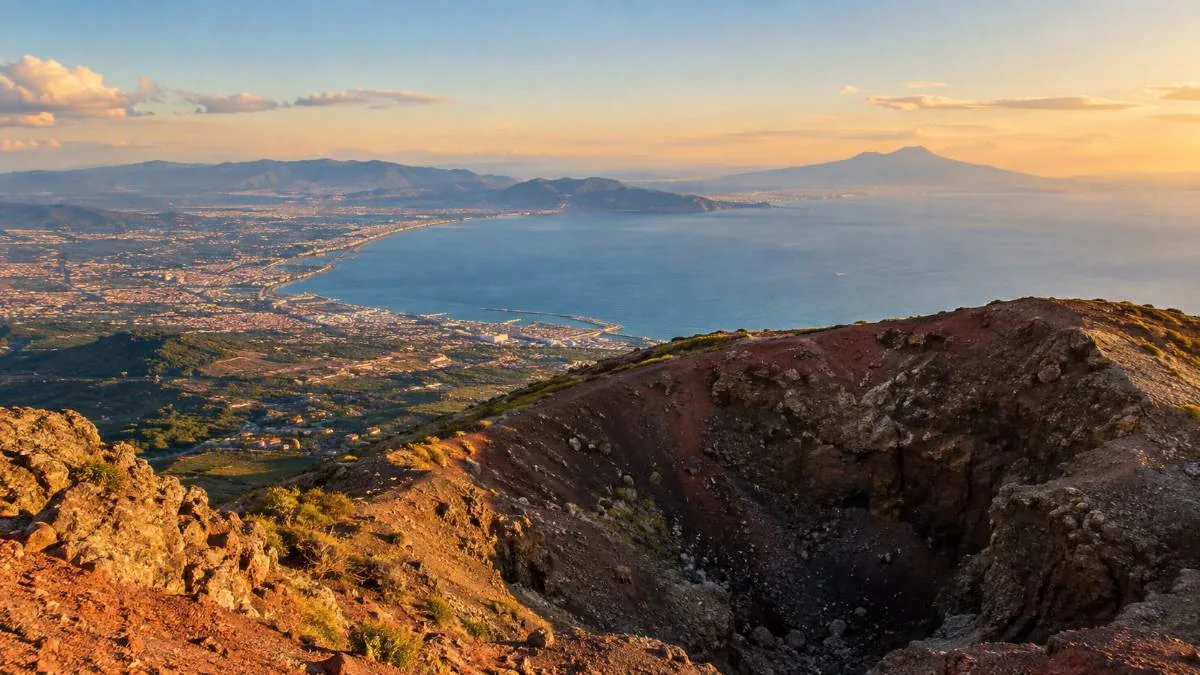
Vesuvius is an active volcano about 1,281 metres high on the Gulf of Naples, dormant since 1944, within a national park established in 1995 where the climb to the crater rim is on foot, along a single trail, with a ticket valid for a pre-booked time slot.
What kind of mountain is it, exactly
It’s not the single cone children draw. Vesuvius is a Somma-stratovolcano: the rim of an older caldera, the Monte Somma, embraces half of the younger cone, and the depression between the two is called Giant’s Valley. Looking at the profile from Naples, you can see two peaks: the jagged one on the left is Monte Somma, the regular one on the right is the Gran Cono.
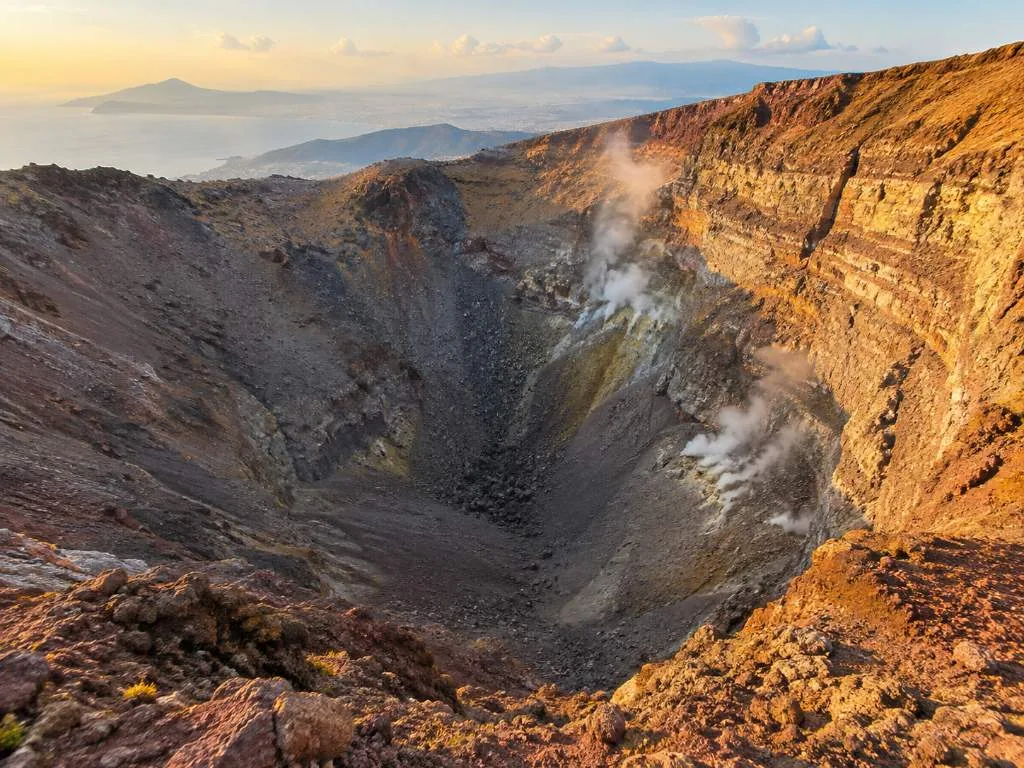
The crater at the top is about 450 metres wide and about 300 metres deep. Steam still rises from the walls: these are the fumaroles. There’s no visible lava, and no lava lake exists. Those who climb expecting red are disappointed.
You’re not buying “the volcano.”
What you book can be up to three separate things: scheduled ticket for the crater trail, the transport up to the park gate, and in some cases a guideThese can be combined in any way. The difference between a successful afternoon and a wasted one rarely lies in the "tour" itself: it’s about having chosen the right combination. The six options are compared in all tours; the single ticket is explained in tickets for Vesuvius.
One thing surprises those who arrive with the song in their head: the funicular from 1880, the one of Funiculì Funiculà, was destroyed in 1944 and was never rebuilt. There is no cable car. Anyone promising you the summit without walking is telling you about a mountain that hasn’t existed for eighty years.
What the trail is like underfoot
The tarmac ends at a parking lot around 1,000 metres. From there, the Trail no. 5, "Il Gran Cono" walk around the cone and climb up to about 1,170 metres: 25–30 minutes for most people, about 4 km round trip including the walk along the rim. The surface is lapillus, loose volcanic gravel: uphill it slows you down, downhill it rolls under your soles and gets into low shoes. The trail is not wheelchair-accessible and cannot be done with a stroller.
I always tell people who ask for advice at the bar: Vesuvio isn’t a difficult mountain, it’s a mountain that punishes the wrong shoes. I’ve seen more people slide down on their backsides because of sandals than because of the slope. The real challenges are in how long the climb takes, the backpack checklist in what to bring.
What you see from up there
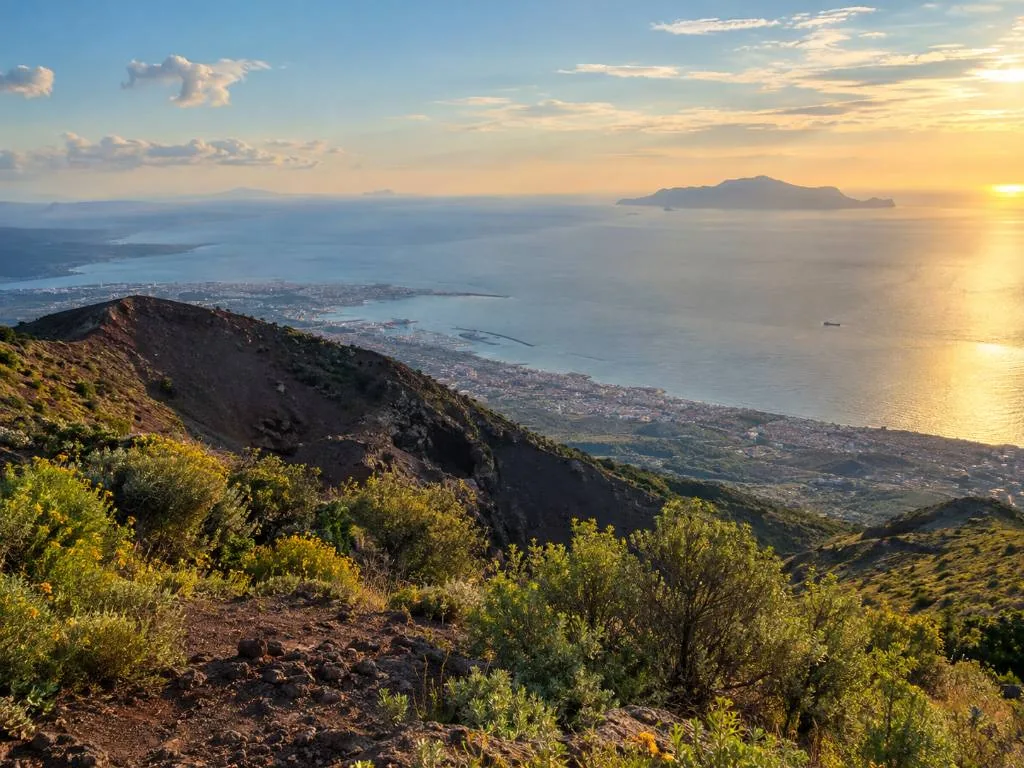
Turning your back to the crater, when the air is clear, the view opens up Bay of Naples in full: Capri, Ischia, Procida, the Sorrento Peninsula, and behind you, the Apennines. On a humid day, instead, you see the parking lot and little else: that’s the risk you take. What you can make out and under what conditions is in what you can see from the crater.
1944, which here is still yesterday
The eruption of AD 79 it buried Pompeii, Herculaneum, Oplontis and Stabiae. Pompeii ended up under lapilli and ash, not under a lava flow, and this is the most common misconception about the whole event. But the date that matters for those who live here is another one: March 1944. The last eruption destroyed much of San Sebastiano al Vesuvio and of Massa di Somma, killed about 26 people and destroyed dozens of Allied B-25 bombers parked at the nearby airfield. My grandmother’s family lost their home in San Sebastiano and moved down to live by the coast: that’s why I was born in Torre del Greco and not up there. The full story is in the last eruption.
The volcano today, without prophecies
Since 1944 Vesuvius has been dormant: low-level seismic activity and fumarolic emissions, no eruption. TheVesuvius Observatory, founded in 1841 and today part of the INGV, is the world’s oldest volcanological observatory, and the mountain is monitored continuously. The red zone of the evacuation plan covers around 25 municipalities and about 700,000 residents; the plan relies on the fact that an eruption would be preceded by measurable signals.
Here you will not find a date, nor the word that newspapers drag out at every anniversary. No one knows. What is known is that it is an active volcano in a quiet phase, monitored more closely than almost any other: Vesuvius active today e a new eruption address the specifics, and on the safety of the ascent the detailed answer lies in is it safe to climb.
The mountain closes, and it’s no one’s fault
Strong winds, storms, and snow can close the Gran Cono trail, sometimes with just a few hours’ notice, in winter as well as spring. On the edge of an open crater, with that kind of terrain, the wind is a serious issue. That’s why the free cancellation and an operator who reorganises, usually redirecting to Ercolano, are more valuable here than on any other excursion in Campania. One of our reviewers, Nicola, found himself in that situation and left a high rating precisely for how it was handled: when the park closes.
Mount Vesuvius or Pompeii
Two separate sites, two separate tickets, two different kinds of fatigue: on one side, a short, windy climb with a view as a reward; on the other, a city to walk through for hours under the sun. Doing both in the same day is a common choice, and half of Campania thrives on it. But you pay for it in time: the stop at the crater’s edge is the first thing to get cut short. If you only have one day, know this beforehand instead of finding out up there. The issue is explored in detail in Mount Vesuvius and Pompeii, and if you’re wondering whether the mountain deserves a spot on your itinerary, the honest answer is in it's worth it.
Ready to book?
The timed-entry ticket with digital guide is the starting point for most visitors. If you prefer someone to explain the fumaroles to you, check the tour with volcanological guide; if you only have one day, consider Pompeii and Vesuvius together.
Frequently asked questions
How long does the climb to Vesuvius’ crater take?
From the parking lot at about 1,000 meters to the crater’s edge, it’s a twenty-five to thirty-minute walk over lapilli. The full loop with the descent is around 4 km. The details are in how long the climb takes.
Do you need to book Vesuvius in advance?
Yes: access to the Gran Cono trail is by time slot and must be booked in advance. How it works is explained on the page. crater tickets.
Is Vesuvius active?
It is an active volcano in a quiescent phase: the last eruption was in March 1944 and since then there have only been fumaroles and background seismicity. See Vesuvius today.
Can you visit Mount Vesuvius and Pompeii in the same day?
Yes, and it’s the most sold option, but it takes time away from both sites. The honest comparison is in Mount Vesuvius and Pompeii.