The last eruption of Vesuvius
What happened in March 1944
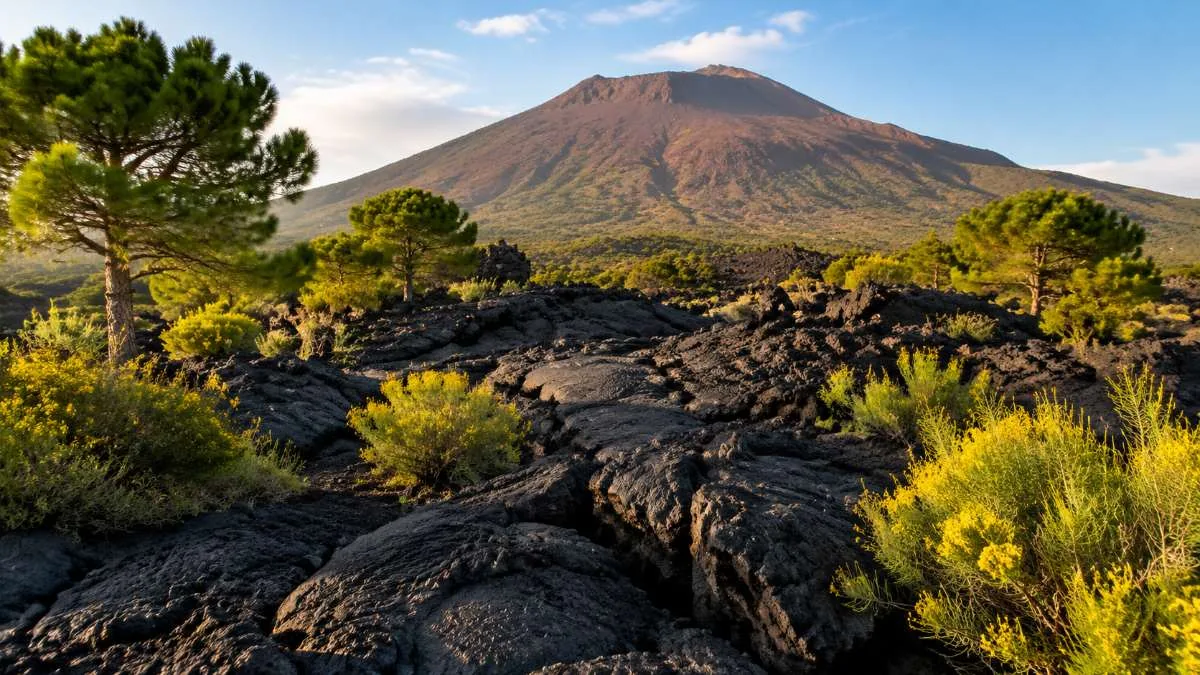
Mount Vesuvius erupted while southern Italy was gripped by war. The lava flow descended toward the towns on the north-western slope and overwhelmed much of San Sebastiano al Vesuvio and Massa di Somma. There were about twenty-six victims. It’s a small number compared to what the eruption destroyed in terms of homes and land, and this shows how much having time to move matters.
The coincidence with the war produced the most cited image of that event: dozens of Allied B-25 bombers, parked at the nearby airfield, were destroyed by ash and lapilli. Photographs of military aircraft buried by a volcano are an image that lingers.
The piece that is still missing today
The eruption also swept away the funicular, the one inaugurated in 1880 and made famous by Funiculì FuniculàIt was never rebuilt, and today no cable car exists. This is why the climb to the crater rim is on foot, twenty-five to thirty minutes from the car park at one thousand metres: the practical explanation lies in how long the climb takes e how to get to Mount Vesuvius.
Eighty years of silence are nothing
Since 1944 Vesuvius has been dormant: low-level seismicity and fumarolic activity, no eruptions. For a human lifespan, this is a long time; for a volcano, it’s just another interval. On what “active but dormant” actually means, we’ve written is Vesuvius active today, and on the civil protection plan and the red zone a new eruption of Vesuvius.
1944 and 79 AD are not the same story
The 79 AD eruption is the one that buried Pompeii, Herculaneum, Oplontis and Stabiae, and it is of a different order of magnitude. Pompeii ended up under lapilli and ash, not under a lava flow, which surprises many visitors. The relationship between the volcano and the excavations lies in Mount Vesuvius and Pompeii. The year 1944, however, is family history: my grandmother’s family lost a house in San Sebastiano and moved to live on the coast. In many homes in Torre del Greco there’s a story like this, always told in the same practical tone.
What you see as you go up
On the crater’s edge, the year 1944 isn’t marked by a sign, but it’s visible: the cone’s walls are layered, and each layer is a phase. With a guide to interpret them, the climb becomes a timeline; without one, they’re just grey rocks. Details on what you actually observe are in what you can see from the crater.
If 1944 really interests you, look at the volcano from below before climbing it: from the towns on the slopes, you can see where the lava flow passed much more clearly than from the rim.
Climb where it happened.
The skip-the-line ticket with digital guide gives you the slot for the Gran Cono trail, with or without the transfer from Naples, Pompeii, or entry to Herculaneum.
Frequently asked questions
When was the last eruption of Mount Vesuvius?
In March 1944. Since then, the volcano has been in a quiet phase, with low-level seismicity and fumarolic activity.
What damage did the 1944 eruption cause?
Destroyed much of San Sebastiano al Vesuvio and Massa di Somma, caused around 26 fatalities, and destroyed dozens of Allied B-25 bombers parked at the nearby airfield.
Why is there no longer a funicular?
It was destroyed by the 1944 eruption and was never rebuilt. Today, the last stretch is done on foot: see how long the climb takes.
Is the 1944 eruption comparable to that of 79 AD?
No, they are on a different scale. The eruption of 79 buried Pompeii, Herculaneum, Oplontis, and Stabiae: we discuss it in Mount Vesuvius and Pompeii.