What you see from the crater
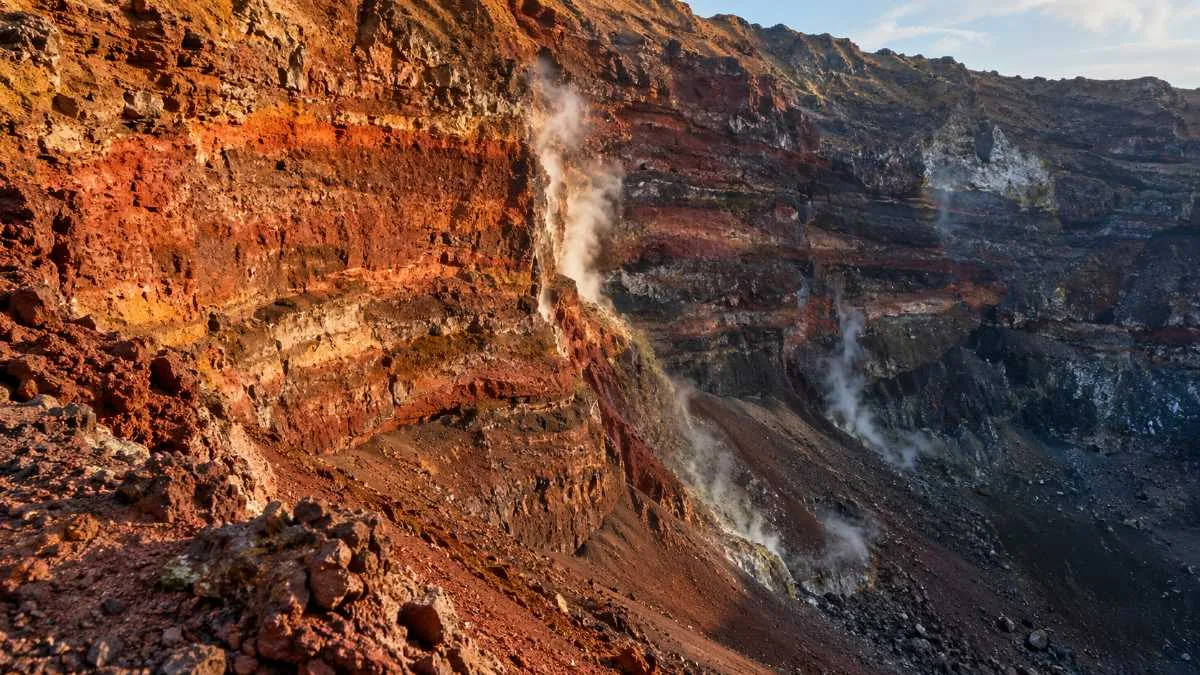
Inside: a hole that tells its story
The crater isn’t as spectacular as those who’ve never been imagine. It’s grey, enormous and silent. The interesting part is the walls: overlapping layers of material, one for each phase, which read like the pages of a book placed on its side. And then the fumaroles, the steam that continues to escape from the cracks, reminding you that something hot is still beneath. Vesuvius has been dormant since 1944, not extinct: we explain the difference in is Vesuvius active today.
It’s also the point where a guide transforms the day. Without someone explaining what those layers are, it remains a big grey hole. With an explanation, it becomes a chronicle of two millennia. The options with a park volcanological guide are in private tours and small groups.
Outside: the view that makes the climb worthwhile
As you walk along the rim, the view changes every fifty metres. Below lie the Vesuvian towns clustered together down to the sea, then the city of Naples, then the bay opening up. When the air is clear, you can see Capri, Ischia and Procida, the outline of the Sorrento peninsula, and turning around, the Apennine mountain range. Kathrin, from Austria, writes that the view of the bay and Capri is unforgettable, and Cornelia talks about the city seen from up there: they are two ways of saying the same thing.
Summer haze is the deciding factor. On humid days, the bay is barely visible, and the same walk feels half as rewarding. After a windy day, however, you can see as far as the Apennines. On how to choose the right time, we’ve written when to visit Vesuvius.
What many expect and don’t find.
What works
- The stratified walls of the crater, seen up close
- The fumaroles that actually smoke, no set design
- The entire bay at a glance, islands included
- The physical sensation of altitude, with tiny villages below
What to know beforehand
- There’s no visible lava, and there’s no lava lake
- You don’t go down into the crater: you walk along the rim.
- With mist, the view shrinks to very little.
- You see the volcano in its full form from below, not from above
The paradox of the rim
From the crater, you don’t see Vesuvius. You’re on top of it. The classic profile, with the jagged Monte Somma embracing half of the younger cone and the Valle del Gigante in between, is visible from the coast and the towns at its base. Those who want both take them in the right order: first the view from afar, then the climb. This is also why the free part of this mountain isn’t a second choice, as we explain in climbing Vesuvius for free.
David, from France, says the climb is worth it both for the view and for understanding the tragedy of 79 AD. It’s the best summary we’ve read: the view is the reward, the context is the meaning. And the context lies below, in the excavations: Mount Vesuvius and Pompeii.
Walk at least a stretch of the rim instead of stopping at the first viewpoint. The difference between those who return happy and those who return puzzled often comes down to this: two hundred more metres and another angle of the bay.
Climb with someone who explains it to you.
The Vesuvius Easy Tour travels by minibus with a small group and a volcanological guide to the park: it’s the best compromise if you’re interested in understanding what you’re looking at.
Frequently asked questions
Can you see lava in the crater of Mount Vesuvius?
No. There is no visible lava or lava lake. What you see is steam from the fumaroles rising from the crater walls.
How large is the crater?
Around 450 meters wide and about 300 meters deep. You walk along the rim: no descent inside.
Can you see Capri from Mount Vesuvius?
On a clear day, yes, along with Ischia, Procida and the Sorrento peninsula. In summer haze, the view shrinks considerably: see when to go.
Is a guide needed to understand what you’re looking at?
It’s not mandatory, but it makes a big difference: without an explanation, the layers of the walls and the fumaroles remain just a large grey hole. The options are in private tours and small groups.