In short, before booking
- Entry is at set times. The Gran Cono ticket is valid for a booked time slot, not for the entire day: how tickets work.
- The road ends at around 1,000 metres. The last 170 metres of elevation gain to the rim, at about 1,170 metres, are done on foot in 25–30 minutes: how long the climb takes.
- The surface is lapilli, volcanic gravel that slides downhill and gets into low shoes. A pair of closed shoes changes the day: what to bring.
- Wind, storms, and snow close the trail, sometimes with just a few hours’ notice. This is why free cancellation matters more than usual here: what happens if the park closes.
- Mount Vesuvius and Pompeii are two separate sites, with two tickets and two different kinds of fatigue. It’s possible to do both in one day, but something will have to give: Mount Vesuvius and Pompeii.
What you are actually booking
On Vesuvius, you don’t buy “the volcano”: you buy up to three separate things, and almost all bad days start from combining them poorly.
1. The ticket
- Entry to Trail no. 5, the Gran Cono, the climb to the crater rim
- Booked time slot: you enter at the chosen time slot, not whenever you arrive
- It’s only valid for the park: the Pompeii ruins have their own ticket
- Does not cover transport to the entrance
2. Transport
- Bus, minibus or transfer from Naples, Pompeii or Herculaneum
- No funicular and no cable car: the 1880 funicular was never rebuilt
- In some options hotel pickup or at the cruise port
- The park’s minibus includes parking, fuel, and tolls
The guide
- Digital guide in Italian, English, Spanish and French on the skip-the-line ticket
- Volcanological guide authorised by the park on the minibus in a small group
- Live guide or audio guide for the day with Pompeii
- In some transfers, there is no guide: you get on and walk on your own
The climb, step by step
What happens from the meeting point to the return, in the order it happens.
The meeting point changes depending on the option: the Gran Cono trail from Herculaneum for those with just the ticket, or Napoli Centrale, Hotel Vittoria, Via Galileo Ferraris in Napoli, Via Roma 32 or Via Villa dei Misteri 1 in Pompei for those who also have transport. From there on, the sequence is the same for everyone.
- The meeting point — Document and voucher ready. Those arriving by their own means should present themselves at the park gate during the time slot printed on the ticket, not before and not much later.
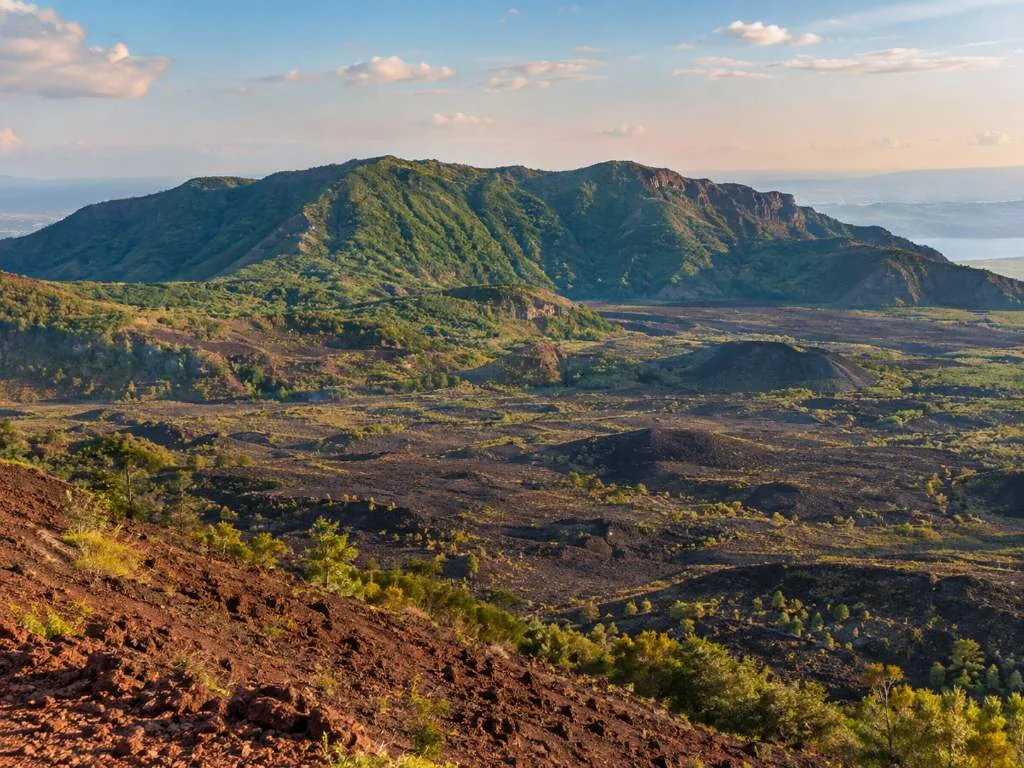
- The road up — Hairpin bends on the volcano’s flank, through cooled lava flows. The landscape changes twice: first the towns, then the black rock.
- The parking lot at 1,000 metres — This is where the tarmac ends and the role of the coach ends. From this point on, everyone walks without exception: there is no vehicle that goes any higher.
- The checkpoint and the start of Trail No. 5 — You show your ticket and pass through. This is when a wrong time slot becomes a real problem, because entries are counted by time slot.
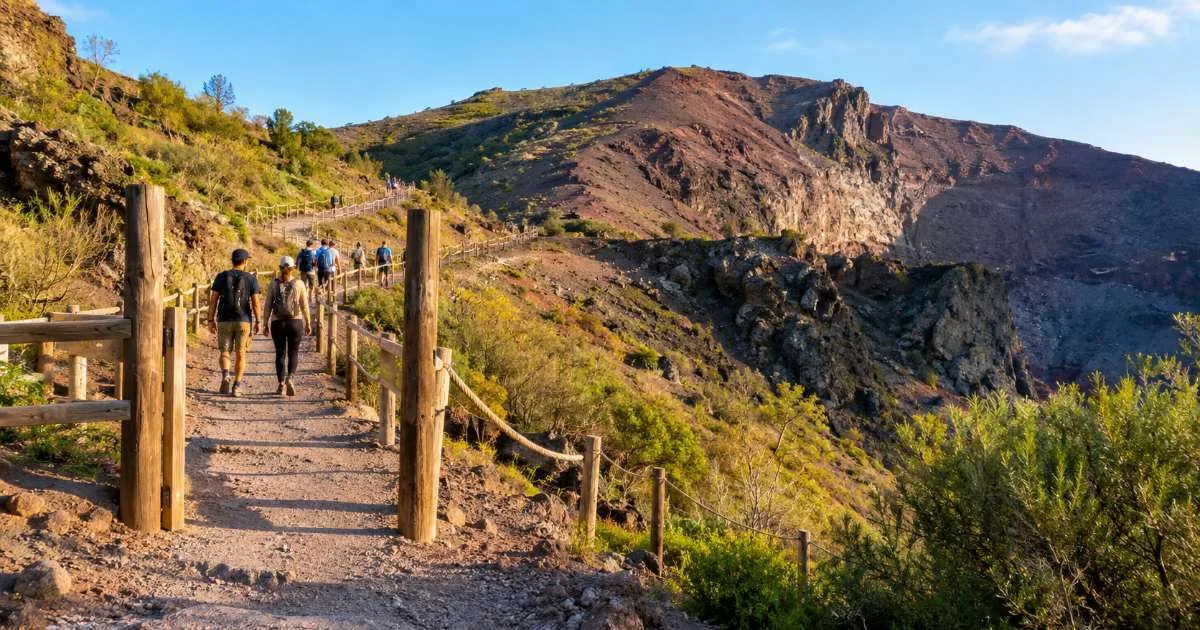
- The climb on volcanic gravel — A wide trail that circles the cone, with volcanic gravel shifting underfoot. Takes 25–30 minutes for most people, including stops.
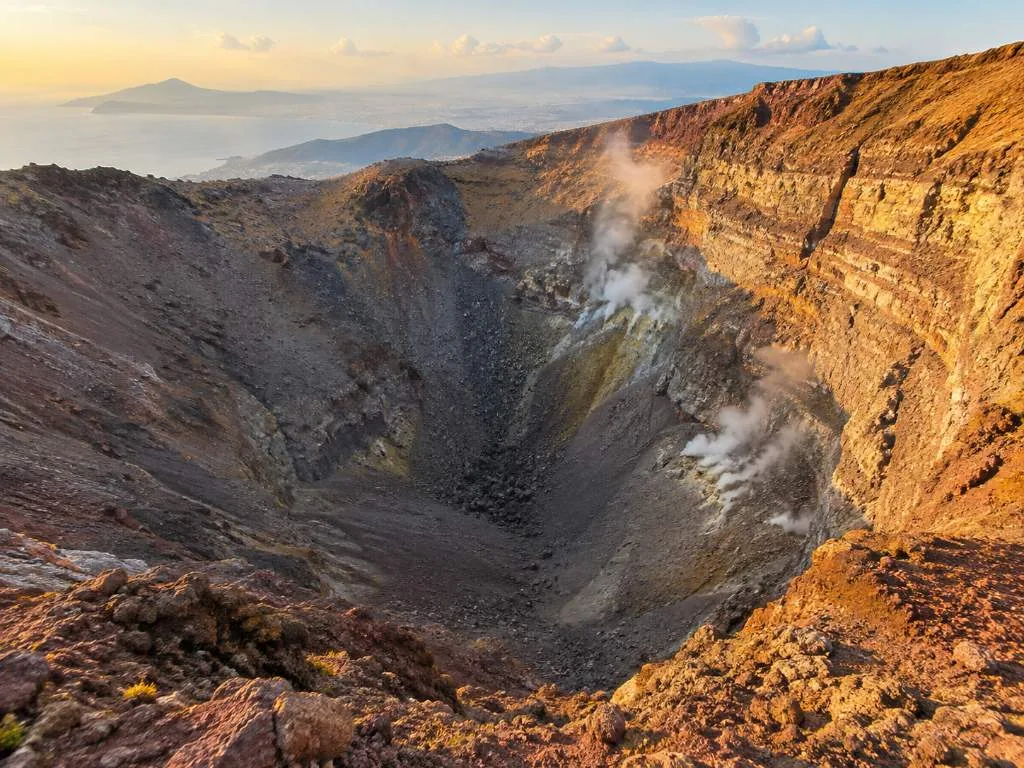
- The crater rim and the fumaroles — The Gran Cono is about 450 metres wide and about 300 metres deep. Steam rises from its walls: those are the fumaroles. There is no visible lava, and there hasn’t been for years.
- The view over the gulf — Turning the other way, with clear air: Naples, Capri, Ischia, Procida, the Sorrento peninsula, and behind you the Apennines. The climb is worth it even on its own.
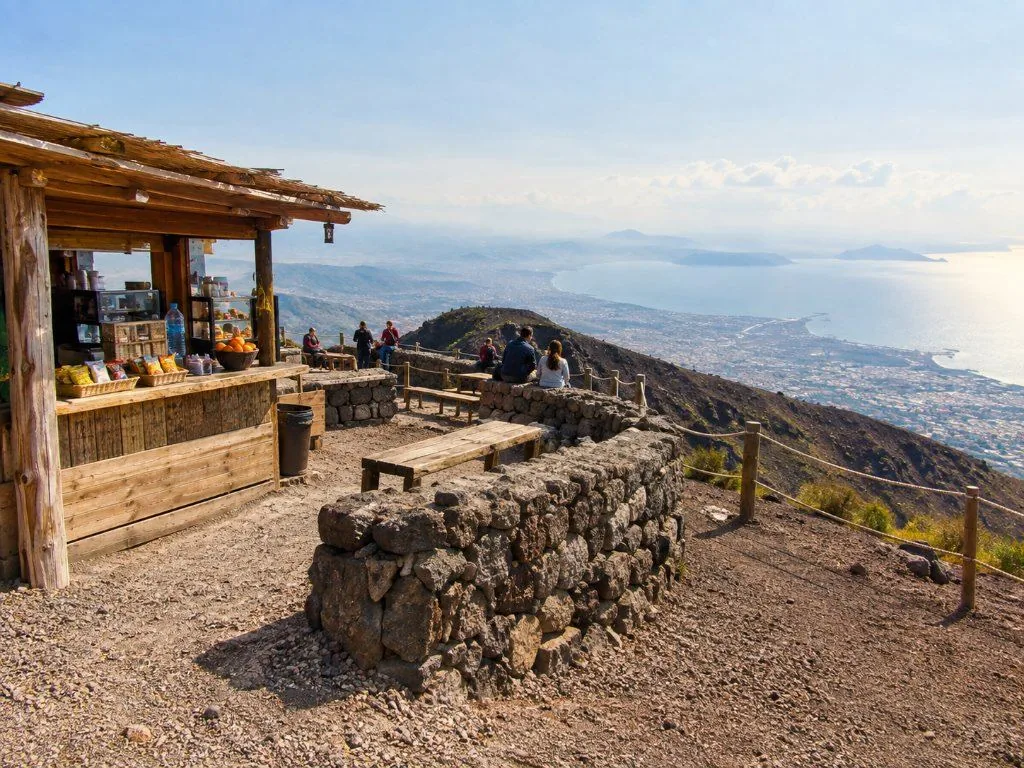
- The descent — Faster and more slippery than the way up, because the lapilli roll. Near the top there are a couple of stalls for water and souvenirs.
From the car park to the rim and back is usually around 4 km and a good hour and a half, including stops at the rim: details, with actual walking times, are in how long the climb takesIf you have never walked on a volcanic gravel trail, read first what to bring.
How to book
Choose your starting point
Ercolano if you have a car or only want the ticket, Naples or Pompeii if you prefer someone else to drive for you. The starting point matters more than the tour itself: see how to get there.
Choose the time slot
Early hours have the best light and fewer people; the afternoon is windier. Some seasonal tips in when to go.
Book and keep your voucher
Immediate confirmation, and on the most booked ticket, cancellation is free up to 24 hours before. On this mountain, that clause really matters.
Arrive during your time slot
Closed shoes, water, a sweatshirt even in July. At the top, the wind is a different story compared to Naples.
Dates and availability for the crater climb
This is the skip-the-line ticket with a digital guide, the most booked option: choose the date, then the time slot and, if needed, the bus from Naples or Pompeii.
Which option makes sense for you
Three different ways to spend the day. The real difference isn’t the tour: it’s how much time you actually spend on the crater’s edge.
| From Pompeii: transfer to the crater with ticket | Our choiceMount Vesuvius: skip-the-line ticket and digital guide | From Naples: Pompeii and Vesuvius in a day | |
|---|---|---|---|
| Duration | 3 hours | 2.5 hours – 1 day | 7 – 7.5 hours |
| Where do you leave from | Pompeii, Via Villa dei Misteri 1 | Herculaneum gate, or Naples or Pompeii | Naples: hotel, cruise port or Napoli Centrale |
| Ticket to the crater | Included | Included, with time slot | Included, plus entry to the ruins |
| Transport | Round trip from Pompeii, with hotel pick-up | Depending on the option: on your own at the gate, or by bus | Full-day bus |
| Guide | Multilingual assistance, no guide at the crater | Digital guide in 4 languages | Live guide or audio guide |
| Actual time at the top | Around 1.5 hours free | You choose, within the time slot | Little: the day is split with Pompeii |
| Suitable for | If you are staying in Pompeii and want zero hassle | Almost everyone, with or without a car. | Who has only one day in Campania |
| What to know | Not recommended for those with mobility issues, heart conditions, or vertigo. | Different meeting points depending on the option chosen: read carefully which one you’ve selected | Lunch with pizza included; not suitable for those with mobility issues |
| Cancellation | What to check in the option before paying | Free up to 24 hours before | What to check in the option before paying |
| Discover → | Book this → | Discover → |
Photo gallery
Mount Vesuvius, from the trail to the rim
What you see as you climb, without filters and without lava.
The six tours we compare
From the ticket only to the full day with Pompeii. Each card links to the operator’s page on GetYourGuide, with updated dates and conditions.
 The most booked
Mount Vesuvius: skip-the-line ticket and digital guide
 Pompeii + Vesuvius
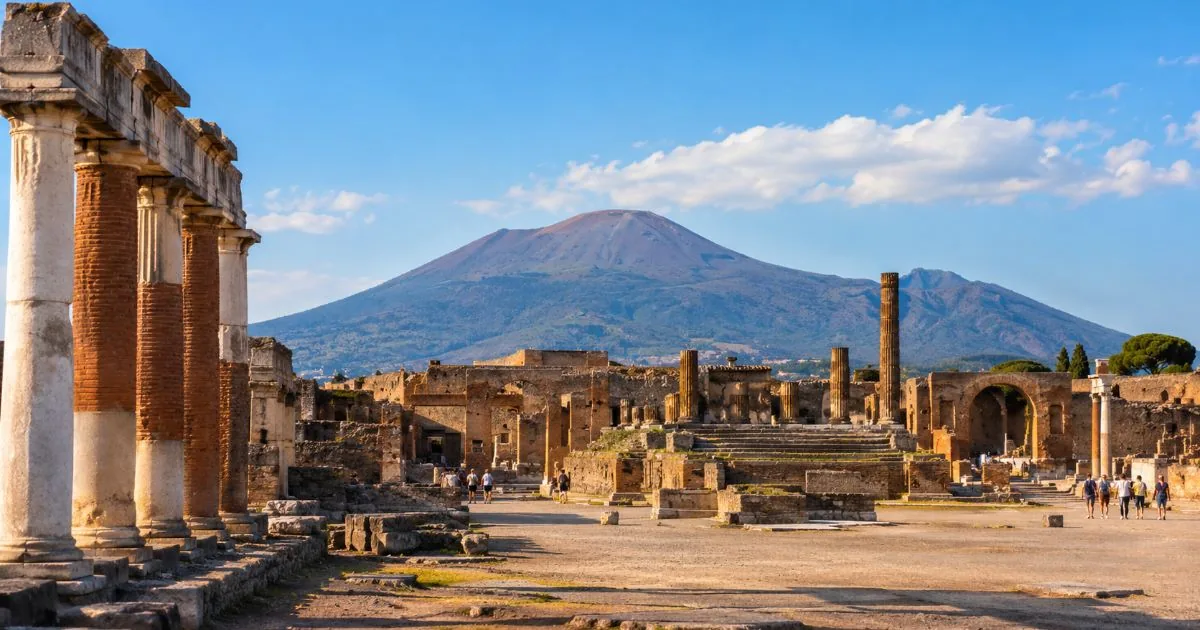
From Naples: Pompeii and Vesuvius in a day
 Volcanological guide
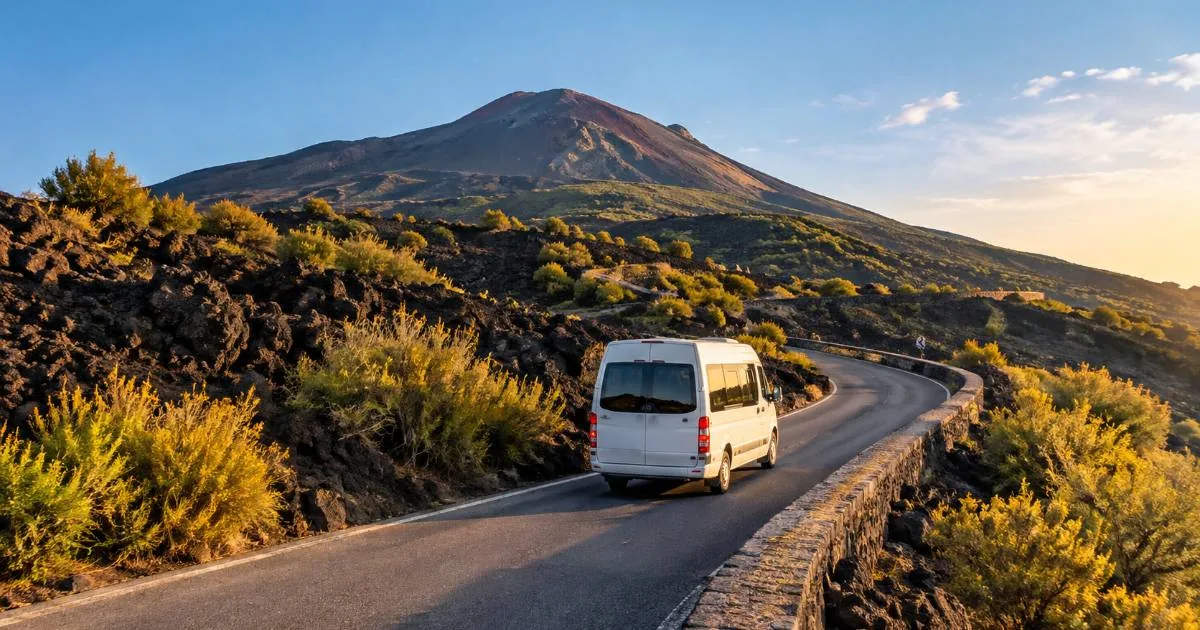
From Naples or Pompeii: Vesuvio Easy Tour
 From Pompeii
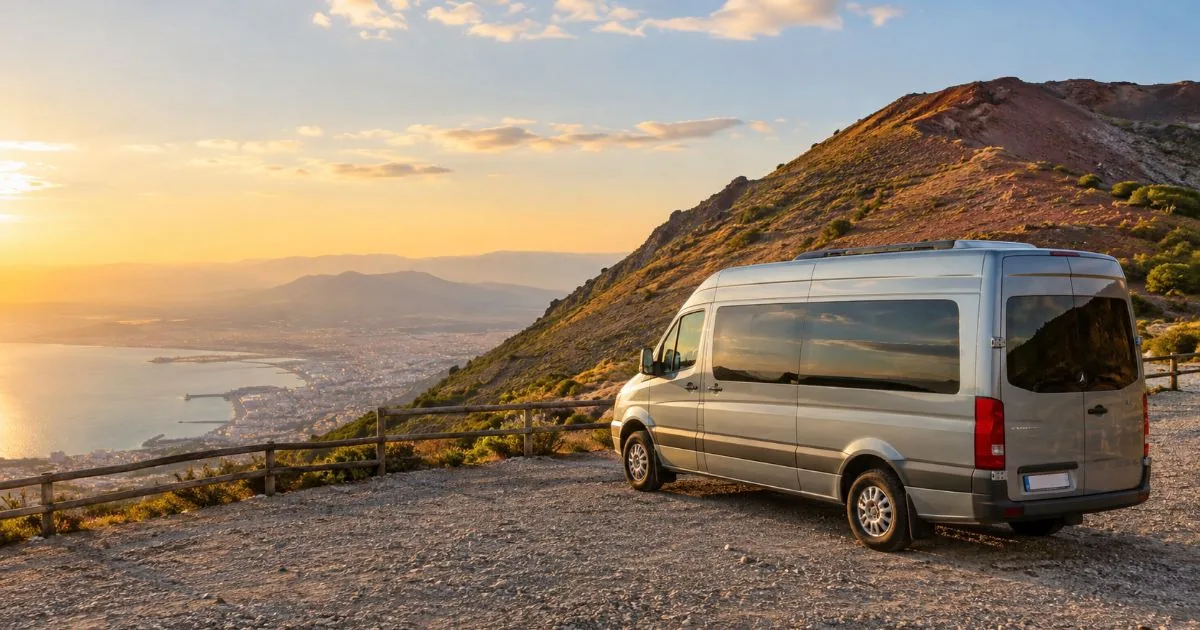
From Pompeii: transfer to the crater with ticket
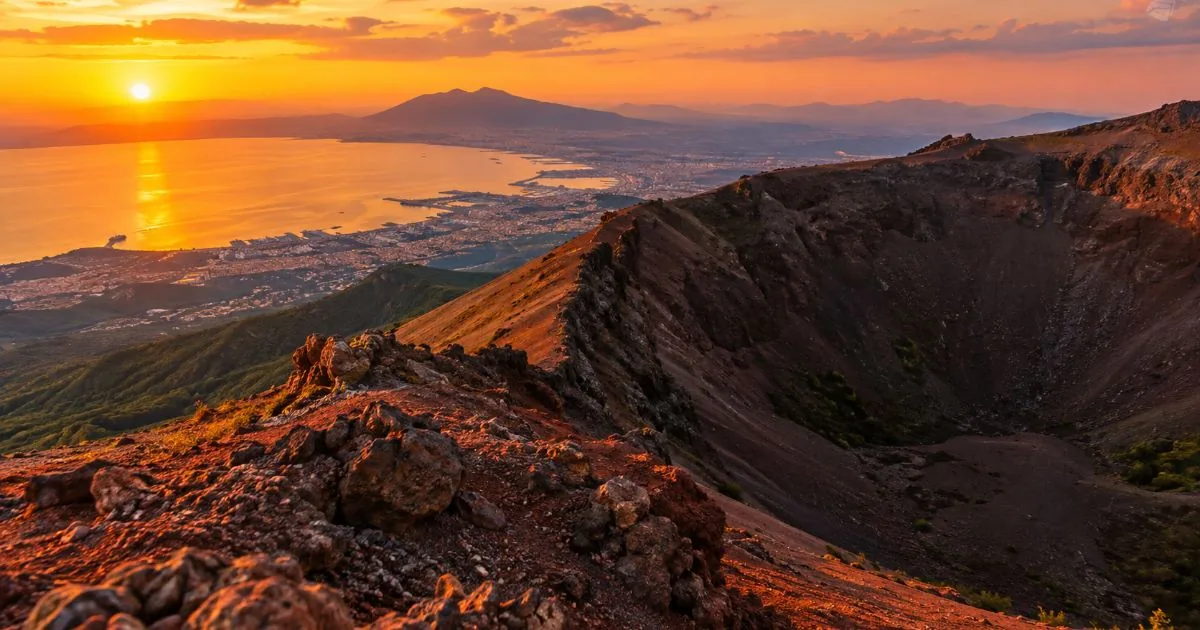 In the afternoon
From Pompeii: Vesuvius at sunset
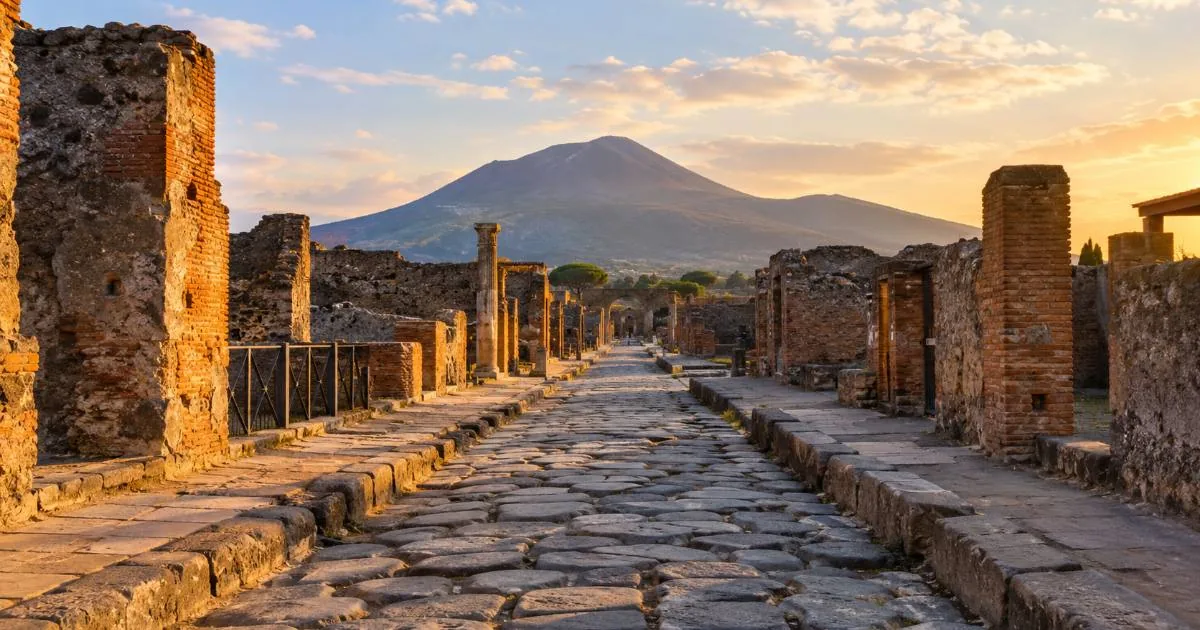 Two sites, one day
From Naples: Vesuvius and Pompeii, round trip
What do people who have been there say
Verified reviews from those who booked the tours we compare here
You climb for the view, but also to understand what really happened in 79 AD.
The view of the city from up there is what stayed with me.
With two hours and forty-five minutes, there was time to climb at a relaxed pace, stay at the top, and descend without rushing.
The park was closed. We were notified immediately and they organised an alternative excursion.
Driver was very punctual, but with those times we didn’t see the sunset.
Excellent transport service, and Pompeii explored at a leisurely pace with the audio guide.
Ratings and number of reviews are live data from operators on GetYourGuide. Read our full reviews ›
The questions we get every week
Brief answers, with the link to the page that goes into detail.
Is Vesuvius active?
Yes. It is an active volcano in a phase of quiescence since 1944: low-level seismicity and fumaroles, no eruption. It is continuously monitored by the Vesuvius Observatory, founded in 1841. The updated overview is in Vesuvius active today.
Can you climb all the way to the crater?
Yes, on Trail No. 5 up to the rim, at about 1,170 metres. You do not descend into the crater: you walk along the rim and look down. How access works is explained in you can go up Vesuvius.
How long does the climb take?
From the car park to the rim takes 25–30 minutes for most people, and about 4 km for the round trip, rim circuit included. Those who walk slowly take a full hour to climb, and that’s normal: see how long the climb takes.
Can you climb for free?
The Gran Cono trail is controlled entry and requires a ticket, so the honest answer is no. What you can do without a ticket are the lower trails in the park and the panoramic viewpoints in the surrounding towns: we list them in climbing Vesuvius without a ticket.
Mount Vesuvius or Pompeii?
They are two different visits: one is an uphill walk with a view, the other is a city to explore on foot for hours. Two sites, two tickets. If you only have one day, read Mount Vesuvius and Pompeii before choosing.
What if the trail is closed?
It happens: strong winds, storms, and snow can stop the ascent, sometimes with just a few hours’ notice. Reliable operators notify you and suggest an alternative, usually Herculaneum. How to handle it is in when the park closes.
Dates not working for you?
Browse the other Vesuvius tours available and find the one that fits your schedule — instant confirmation and free cancellation.
Mount Vesuvius, explained
Vesuvius is an active volcano about 1,281 metres high on the Gulf of Naples, dormant since 1944, within a national park established in 1995 where the climb to the crater rim is on foot, along a single trail, with a ticket valid for a pre-booked time slot.
What kind of mountain is it, exactly
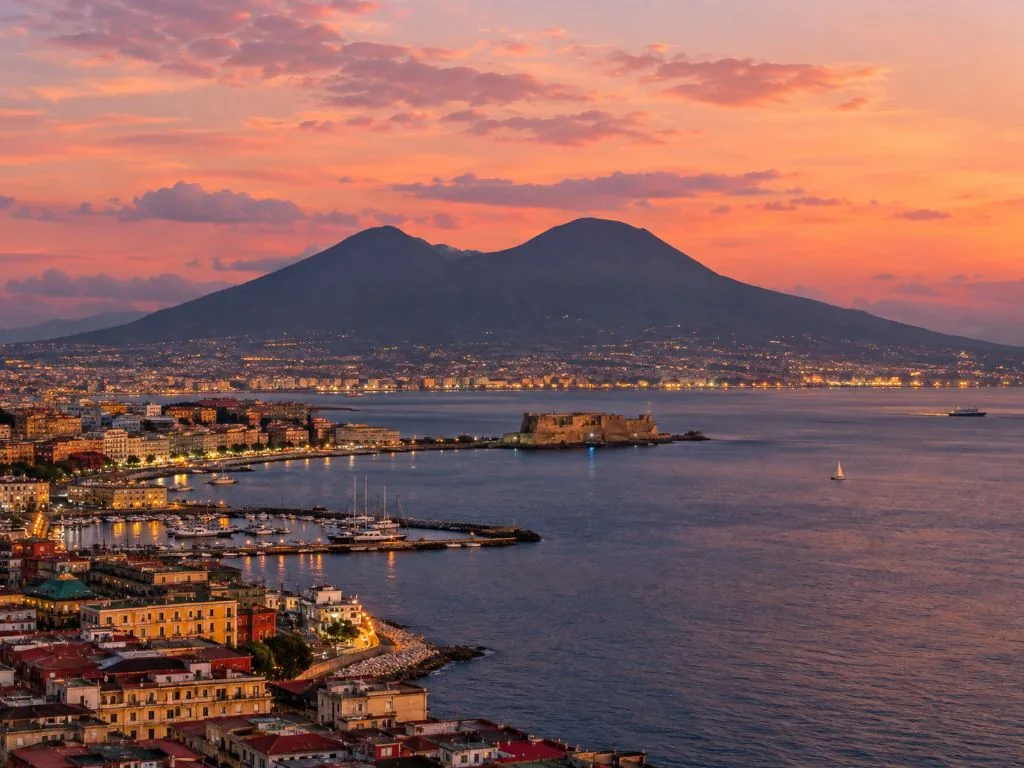
It’s not the single cone children draw. Vesuvius is a Somma-stratovolcano: the rim of an older caldera, the Monte Somma, embraces half of the younger cone, and the depression between the two is called Giant’s Valley. Looking at the profile from Naples, you can see two peaks: the jagged one on the left is Monte Somma, the regular one on the right is the Gran Cono.
The crater at the top is about 450 metres wide and about 300 metres deep. Steam still rises from the walls: these are the fumaroles. There’s no visible lava, and no lava lake exists. Those who climb expecting red are disappointed.
You’re not buying “the volcano.”
What you book can be up to three separate things: scheduled ticket for the crater trail, the transport up to the park gate, and in some cases a guideThese can be combined in any way. The difference between a successful afternoon and a wasted one rarely lies in the "tour" itself: it’s about having chosen the right combination. The six options are compared in all tours; the single ticket is explained in tickets for Vesuvius.
One thing surprises those who arrive with the song in their head: the funicular from 1880, the one of Funiculì Funiculà, was destroyed in 1944 and was never rebuilt. There is no cable car. Anyone promising you the summit without walking is telling you about a mountain that hasn’t existed for eighty years.
What the trail is like underfoot
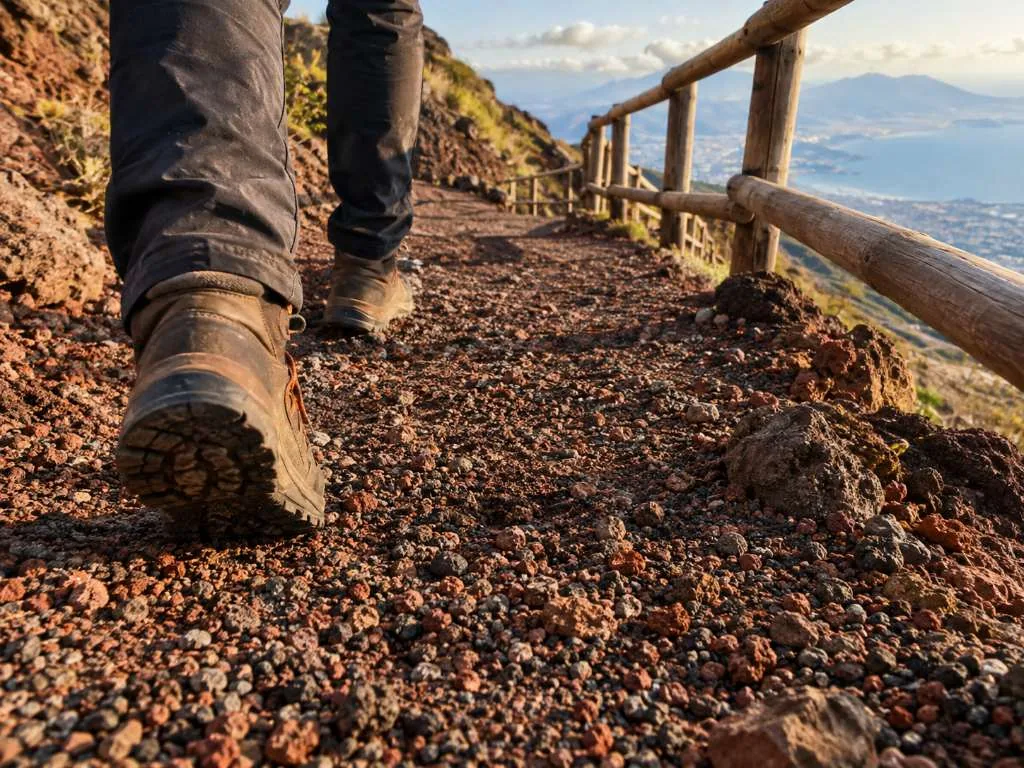
The tarmac ends at a parking lot around 1,000 metres. From there, the Trail no. 5, "Il Gran Cono" walk around the cone and climb up to about 1,170 metres: 25–30 minutes for most people, about 4 km round trip including the walk along the rim. The surface is lapillus, loose volcanic gravel: uphill it slows you down, downhill it rolls under your soles and gets into low shoes. The trail is not wheelchair-accessible and cannot be done with a stroller.
I always tell people who ask for advice at the bar: Vesuvio isn’t a difficult mountain, it’s a mountain that punishes the wrong shoes. I’ve seen more people slide down on their backsides because of sandals than because of the slope. The real challenges are in how long the climb takes, the backpack checklist in what to bring.
What you see from up there
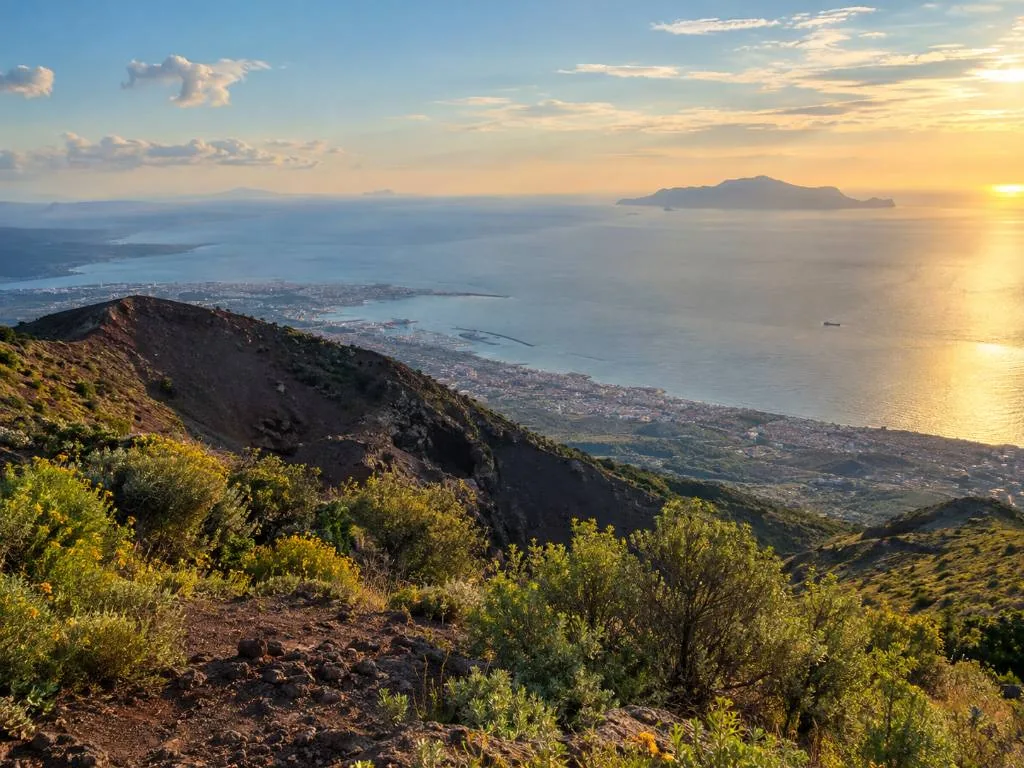
Turning your back to the crater, when the air is clear, the view opens up Bay of Naples in full: Capri, Ischia, Procida, the Sorrento Peninsula, and behind you, the Apennines. On a humid day, instead, you see the parking lot and little else: that’s the risk you take. What you can make out and under what conditions is in what you can see from the crater.
1944, which here is still yesterday
The eruption of AD 79 it buried Pompeii, Herculaneum, Oplontis and Stabiae. Pompeii ended up under lapilli and ash, not under a lava flow, and this is the most common misconception about the whole event. But the date that matters for those who live here is another one: March 1944. The last eruption destroyed much of San Sebastiano al Vesuvio and of Massa di Somma, killed about 26 people and destroyed dozens of Allied B-25 bombers parked at the nearby airfield. My grandmother’s family lost their home in San Sebastiano and moved down to live by the coast: that’s why I was born in Torre del Greco and not up there. The full story is in the last eruption.
The volcano today, without prophecies
Since 1944 Vesuvius has been dormant: low-level seismic activity and fumarolic emissions, no eruption. TheVesuvius Observatory, founded in 1841 and today part of the INGV, is the world’s oldest volcanological observatory, and the mountain is monitored continuously. The red zone of the evacuation plan covers around 25 municipalities and about 700,000 residents; the plan relies on the fact that an eruption would be preceded by measurable signals.
Here you will not find a date, nor the word that newspapers drag out at every anniversary. No one knows. What is known is that it is an active volcano in a quiet phase, monitored more closely than almost any other: Vesuvius active today e a new eruption address the specifics, and on the safety of the ascent the detailed answer lies in is it safe to climb.
The mountain closes, and it’s no one’s fault
Strong winds, storms, and snow can close the Gran Cono trail, sometimes with just a few hours’ notice, in winter as well as spring. On the edge of an open crater, with that kind of terrain, the wind is a serious issue. That’s why the free cancellation and an operator who reorganises, usually redirecting to Ercolano, are more valuable here than on any other excursion in Campania. One of our reviewers, Nicola, found himself in that situation and left a high rating precisely for how it was handled: when the park closes.
Mount Vesuvius or Pompeii
Two separate sites, two separate tickets, two different kinds of fatigue: on one side, a short, windy climb with a view as a reward; on the other, a city to walk through for hours under the sun. Doing both in the same day is a common choice, and half of Campania thrives on it. But you pay for it in time: the stop at the crater’s edge is the first thing to get cut short. If you only have one day, know this beforehand instead of finding out up there. The issue is explored in detail in Mount Vesuvius and Pompeii, and if you’re wondering whether the mountain deserves a spot on your itinerary, the honest answer is in it's worth it.
Frequently asked questions
Is Vesuvius still active?
Yes, and it is one of the most monitored volcanoes in the world. Since 1944, it has been in a phase of quiescence: low-level seismicity and fumaroles on the crater walls, no eruption. The Vesuvius Observatory has been monitoring it since 1841. The current situation is in Vesuvius active today.
Can you actually get all the way to the crater?
You reach the rim, at about 1,170 metres, by walking along Trail No. 5. From the rim, you can see the Gran Cono, about 450 metres wide and 300 metres deep, with fumarole steam rising from the walls. You cannot descend inside. Details in you can go up Vesuvius.
How long does it take from the car park to the summit?
Around 25–30 minutes uphill for most people, on a volcanic gravel trail. Including the walk around the rim and descent, the total is about 4 km. Real walking times, including those who go slowly, are covered in how long the climb takes.
Do you need to book in advance?
Yes. Entry to the crater trail is by time slot, so the ticket is purchased in advance and is valid for the chosen slot. Arriving outside the designated time is the most common way to ruin your day. How it works: tickets for Vesuvius.
How to get to Mount Vesuvius from Naples?
By bus or minibus from the city centre, or by arriving independently in Ercolano and climbing from there. There is no longer any funicular or cable car: the one from 1880 was destroyed in 1944 and was never rebuilt. All the combinations are in how to get to Mount Vesuvius.
Can you climb Mount Vesuvius without a ticket?
Not on the Gran Cono: that trail is regulated and requires a ticket. The lower trails in the park and the panoramic spots in the towns on the slopes remain free, but they’re a different experience. We discuss this plainly in climbing Vesuvius without a ticket.
What happens if the park closes due to bad weather?
Strong winds, storms, and snow close the trail even with just a few hours’ notice, and it’s no one’s fault. Operators notify you and usually suggest an alternative, often Herculaneum. That’s why it’s worth choosing an option with free cancellation here: when the park closes.
What shoes do you need?
Closed shoes with a grippy sole. The ground is lapilli, volcanic gravel that rolls: on the descent, sandals become a problem and the pebbles get inside. You’ll also need water, a hat and a sweatshirt for the wind at the rim. Full list in what to bring.
Can you visit Pompeii and Mount Vesuvius in the same day?
Yes, and it’s the most sold choice in Campania. However, you pay for it in time: something gets shortened, usually the stop at the crater’s edge. If you accept the compromise, it makes sense; if you care about the mountain, keep them separate. See Mount Vesuvius and Pompeii and the tour that combines them.
Is it suitable for children or those with mobility issues?
Suitable for children who can walk, at a gentle pace and with the right shoes. The trail is not wheelchair-accessible and cannot be navigated with a stroller, and several operators advise against it for those with heart conditions or who suffer from vertigo. We discuss this in Visiting Mount Vesuvius with children and elderly relatives.
Still have doubts? Write to us at [email protected]